

In our previous blog, “Interventions in Mathematics Part 1: A Model that Works“, we emphasized the importance of interventions and the necessity of using data to provide informed and effective intervention. In this blog, we share a detailed description of the tiers of support and highlight the relationship among them.
The Tiers of Support
The model operates on a multi-tiered system, where support is provided at different levels.
Tier 1 – Core instruction
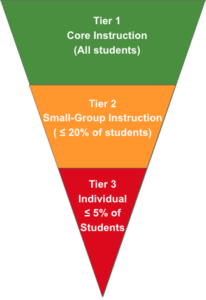
Also known as “core instruction,” this is the mathematics instruction that all students receive. Fundamental to MTSS is the idea that core instruction must be of the highest quality for all students. A well-known fact among experts in the model is this: no amount of intervention can compensate for deficiencies in the quality of core instruction. If you think that this is obvious, you might be surprised to know that recommending students for intervention at the first sign of trouble is a common practice and, therefore, a major challenge in the implementation of MTSS. Thus, decisions about who should receive intervention are not left solely to the math teacher; rather, a team of educators—including the math teacher and school leadership—collaborates to analyze the data and make final recommendations on which students should receive intervention services. Screeners are then administered to all students to flag any potential issues. A second common pitfall in the implementation of the model is that many have come to view the screener as the tool for prescribing interventions. This unfortunate misunderstanding has led to misinterpretation of the data. To be clear, the purpose of the screener is not to prescribe; rather, it is intended as a flagging tool that should be followed by more refined tools—a diagnostic assessment, in order to prevent acting on false positives.
Tier 2 – Intervention
After a specific math skill has been properly identified, diagnosed, and prescribed for a student or a small group of students, those student(s) receive an academic intervention. The intervention must be tailored to the identified math skill and facilitated in a small-group setting with other students who have similar needs.
Five important aspects of effective implementation of MTSS that should be considered.
First, the math skills selected for intervention must be essential for success at that particular grade level. Second, every effort should be made to teach that skill to all students during core instruction (Tier 1). If some students are not responding to the support provided in Tier 1, further adjustments to core instruction should be made before considering a Tier 2 intervention.
Third, it’s important to keep in mind the number of students who could potentially receive a Tier 2 intervention. A good rule of thumb is that no more than 20% of all students in the math class should receive this intervention. This makes sense when considering an extreme situation: if, after teaching a specific math skill in the regular class, we find that 100% of students in the class did not grasp it and therefore need additional instruction, it stands to reason that the appropriate place to address that need is in the regular math class (Tier 1), and not during an intervention (Tier 2). Thus, we need a cutoff number to determine whether a skill should be addressed in the regular class or only for those students who need more support—this number is 20% of the class, no more.
Fourth, the curriculum materials and teaching practices used in the Tier 2 intervention must be proven to be effective; that is, both should be supported by research.
Fifth, students receiving the Tier 2 intervention must undergo progress monitoring assessments to evaluate how they are responding to the intervention. If the assessment reveals that they are not making progress, then the intervention is not working, and further adjustments should be considered.
Tier 3 – Intensive Intervention
The next level is ‘intensive’ intervention. Students who are not benefiting from Tier 2 intervention would then require more intensive support (i.e., Tier 3). If you are wondering what is meant by ‘intensive,’ you are not alone. The difference between Tier 2 and Tier 3 is significant but also sensible. For the intervention to be considered ‘intensive,’ two factors must be changed: attention and time.
By attention, we mean the ratio of adults (or interventionists) to students. In a Tier 2 setting, the configuration might be one interventionist for every five students, while in Tier 3, the recommended configuration is one-to-one (or perhaps one-to-two). The second factor, ‘time,’ as you might suspect, refers to increased frequency—more sessions per week, potentially every day if necessary.
Likewise, a proper and effective implementation of Tier 3 intervention must consider similar aspects to those we mentioned before. First, consider the number of students who could potentially receive a Tier 3 intervention. A good rule of thumb is that no more than 5% of all students in the math class should receive this intervention. The same reasoning we used for Tier 2 applies to Tier 3. If too many students need support beyond Tiers 1 and 2, then something else is amiss. A deeper analysis would be needed to uncover the root causes and determine how to address them. (Fuchs et al., 2021)
Also, like the prior tiers, the curriculum materials and teaching practices must be backed by research, and progress monitoring should be administered. You may wonder: what happens if a student is still not ‘responding’ to Tier 3 intervention? Well, the answer is that at this point, the student can be referred for an evaluation for special education.
Next Blog
In our focus on intervention, we have thus far examined its importance and structure. In our concluding blog, we will turn to the vital question of implementation.
References
Fashola, O. S. (2002). Building Effective Afterschool Programs. SAGE Publications.
Fuchs, L. S., Bucka, N., Clarke, B., Dougherty, B., Jordan, N. C., Karp, K. S., & Woodward, J. (2021, March). Assisting Students Struggling with Mathematics: Intervention in the Elementary Grades (WWC 2021006). Washington, DC: National Center for Education Evaluation and Regional Assistance (NCEE), Institute of Education Sciences, U.S. Department of Education. https://whatworks.ed.gov
Gersten, R., Beckmann, S., Clarke, B., Foegen, A., Marsh, L., Star, J., & Witzel, B. (2009). Assisting Students Struggling with Mathematics: Response to Intervention (RtI) for Elementary and Middle Schools (NCEE 2009-4060). National Center for Education Evaluation and Regional Assistance, Institute of Education Sciences, U.S. Department of Education. https://ies.ed.gov/ncee/wwc/publications/practiceguides/
Gordon, E. W., & Rajagopalan, K. (2016). The Testing and Learning Revolution: The Future of Assessment in Education. Palgrave Macmillan.
Grossman, J. B., Price, M. L., Fellerath, V., Jucovy, L. Z., Kotloff, L. J., & Raley, R. (2002). Multiple Choices After School: Findings from the Extended-Service Schools Initiative [Executive Summary]. Public/ Private Ventures.
Hamilton, L., Halverson, R., Jackson, S. S., Mandinach, E., Supovitz, J. A., & Wayman, J. C. (2009). Using student achievement data to support instructional decision making (NCEE 2009-4067). Washington, DC: National Center for Education Evaluation and Regional Assistance, Institute of Education Sciences, U.S. Department of Education. https://ies.ed.gov/ncee/wwc/publications/practiceguides
Hattie, J., Fisher, D., Frey, N., Gojak, L. M., Moore, S. D., & Mellman, W. (2016). Visible Learning for Mathematics, Grades K-12: What Works Best to Optimize Student Learning. SAGE Publications.
Irwin, V., Wang, K., Jung, J., Kessler, E., Tezil, T., Alhassani, S., & Filbey, A. (2024, May 30). Condition of Education 2024. National Center for Education Statistics. Retrieved November 3, 2024, from https://nces.ed.gov/pubsearch/pubsinfo.asp?pubid=2024144
National Center on Intensive Intervention (NCII). (2019). 2019 Call for Submissions of Academic Progress Monitoring Tools. https://intensiveintervention.org/sites/default/files/NCII_AcadProgMonitoring_CallForSubmissions_Aug2019.pdf
National Education Technology Plan. (2017). Future Ready Learning: Reimagining the Role of Technology in Education. https://tech.ed.gov/files/2017/01/NETP17.pdf
Outhwaite, L. A., Aunio, P., & Ka Yu Leung, J. (2024, September 5). Measuring Mathematical Skills in Early Childhood: a Systematic Review of the Psychometric Properties of Early Maths Assessments and Screeners. Educational Psychology Review, 36(110), 2-71. https://link.springer.com/article/10.1007/s10648-024-09950-6
Preston, A. I., Wood, C. L., & Stecker, P. M. (2016, Aug 25). Response to Intervention: Where It Came From and Where It’s Going. Preventing School Failure: Alternative Education for Children and Youth, 60(3), 1-10. https://doi.org/10.1080/1045988X.2015.1065399
Somers, M.-A., Welbeck, R., Grossman, J. B., & Gooden, S. (2015, March). An Analysis of the Effects of an Academic Summer Program for Middle School Students. MDRC publications.
STEM; NYC DOE. (2022, June). Multi-Multi-Tiered System of Supports for Mathematics (MTSS-M).