
Furthermore, review of the literature yields a few attributes of high-quality professional learning activities as being centered around a community, are cohesive, of sufficient duration, engaged in active learning, focused on content knowledge and be tied to quality curriculum materials (Yoon et al., 2007). So in this paper, we will make a case for an approach to professional learning experience that integrates different modalities, focuses on collaboration and addresses the real challenges teachers face in the classroom as well as the challenges of implementing a true collaborative of professional learning (CPL) program.
This vision calls for a collaborative professional learning experience designed for a yearlong commitment, focusing on job-embedded support to address specific problems of practice. Integrating both in-person and virtual interactions with groups of educators, serving as a think tank to provide ideas and feedback to the school-based team. This team would be responsible for investigating solutions to the identified problems of practice and producing evidence of progress with a report that would help other leaders evaluate and replicate the experience.
A Matter of Duration
When considering the duration of a CPL program, it is important to acknowledge the complexity of learning and teaching mathematics. Despite what some may believe, effective teaching is challenging. This is one of the reasons single sessions of professional learning activities have limited effect in improving teaching practices or providing opportunities for meaningful collaboration. Multiple sessions, distributed over time and connected by a purposeful arc of learning, are far favored by the majority of math educators (Russell et al., 2020). This vision goes a step further by proposing that this arc of learning should span the entire duration of the academic school year, so that participants in a CPL program begin and end the year together. Other important considerations include whether to hold the sessions virtually or in person, as well as addressing individual needs and job-embedded support. We will explore these considerations to make a case for a learning experience that would enact this vision for collaborative professional learning.
A Matter of Quality and Cost:
Despite significant technological advances, there is something to be said for in-person connections with colleagues. Looking them in the eye as they explain their strategies often has a profound impact (Bengo, 2016). Similarly, understanding their concerns about how something might work with their specific students is less likely to be misunderstood. Moreover, physical presence facilitates ongoing feedback loops between facilitators and participants. Given the social nature of people, we acknowledge that virtual learning experiences may not have the same impact as in-person experiences. However, in-person sessions come at a high cost, including salaries for facilitators, substitute teachers, commuting, food, and other expenses—alongside the immeasurable cost of a lost instructional day for students.
A Matter of Time and Attention:
That said, virtual professional learning can be an effective alternative. With interactive documents, breakout rooms, and shared boards, virtual sessions offer potential for effective learning experiences (Linchtenstein & Phillips, 2021). Commuting to non-local PL destinations often adds stress and time to our already busy lives. Moreover, the impact on school communities from teacher absences is considerable. Virtual PL sessions provide an attractive and cost-effective solution to these challenges. While it’s more convenient to find two hours in the day for a Zoom session as compared to scheduling a full day at an external location; dedicating undivided attention and time to virtual sessions isn’t always feasible. Despite our best efforts, PL in the school settings invites distractions—from students and colleagues to leadership demands, and our sense of responsibility. In it is the case that being in the school site while attending a virtual session invites distractions. One might wonder if the greatest benefit of attending an off-site PL session is the luxury of uninterrupted time and attention.
A Matter of Trust and Effort
Bringing up the word “coaching” in the context of teaching often elicits biases, as many people have different definitions of what it means to provide “coaching” to a teacher (Bengo, 2016, 88). From observation and feedback to goal-setting and problem-solving, “coaching” is used to describe a wide range of support for a teacher. However, I believe that two key attributes that the concept of “coaching” aims to capture are individualized and job-embedded support. I will use the word ‘coaching’ to mean this aspect of ‘job-embedded’ support and limit its scope to a few straightforward activities.
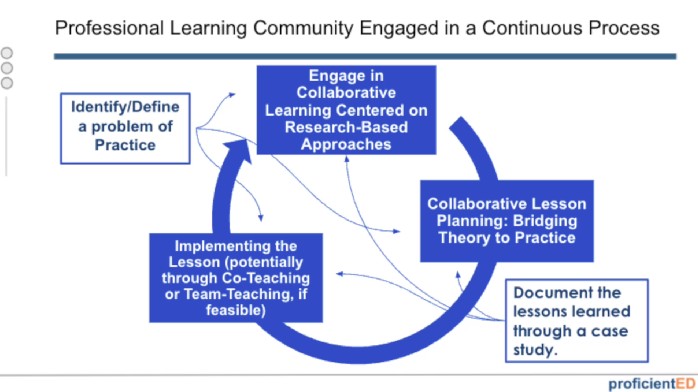
I have been reflecting on the concept of job-embedded support throughout my career and I have witnessed both its power and its limitations. In my experience, a CPL program should include a component of job-embedded support that is straightforward and rooted in a few steps, such as: set goals, co-plan, co-implement, and use a tool to analyze the lesson. Then, repeat the cycle again and again. This process, which integrates insights from previous trials, has the potential to generate an uplifting spiral of continuous improvement.
From all other modalities of support, working closely with a coach in a job-embedded activity requires trust and effort (Russell et al., 2020, 442). The investment of time for true exchange of ideas during planning sessions, the courage it takes to deliver the lesson together and the objectivity necessary to analyze the results cannot be accomplished without trust between the coach, the teacher and the school leadership. The kind of trust that is secure in the knowledge that no one is out to get the teachers or the coach. The feeling that it is a safe space to try things together and learn together. In this sense a coach serves as a thought partner to the teacher.
The coach in this model serves as an experienced advisor, akin to an expert consultant, possessing deep knowledge of literature in mathematics education and extensive exposure to national trends in math education. This expertise is crucial for supporting the school in selecting and facilitating the theoretical framework that will underpin efforts to address the problem of practice.
It’s essential to emphasize that if a coach with this high level of expertise is not available, then the coach should collaborate closely with someone who does, such as an expert or researcher. This ensures that the teacher and coach can effectively lead broader discussions involving collaborators from across the district.
A Matter of Alignment and Scalability
There are various dimensions of alignment, from curriculum alignment to district vision and school leadership goals, all of which are crucial (National Council of Teachers of Mathematics, 2024). Another vital dimension to consider is vertical alignment of participation and membership. A collaborative professional learning (CPL) experience that is vertically aligned involves enrollment across the entire vertical structure, encompassing classrooms, schools, and districts. Leaders and members from all three levels participate in the CPL. Such engagement can enhance scalability.
Another important consideration to enact this vision for professional learning are the ideas of sustainability and scalability. It stands to reason that the success of the model proposed in this vision should be judged by whether or not it can be replicated in other schools across the district. To this end, it is essential that the teacher and coach document each cycle, including artifacts such as planning notes, protocols used, theoretical framework highlights, student work, and video clips. These artifacts can then be repurposed to generate a ‘case study’ that serves as a manual for other schools across the district. This would be a valuable deliverable that fosters both sustainability and scalability.
Summary
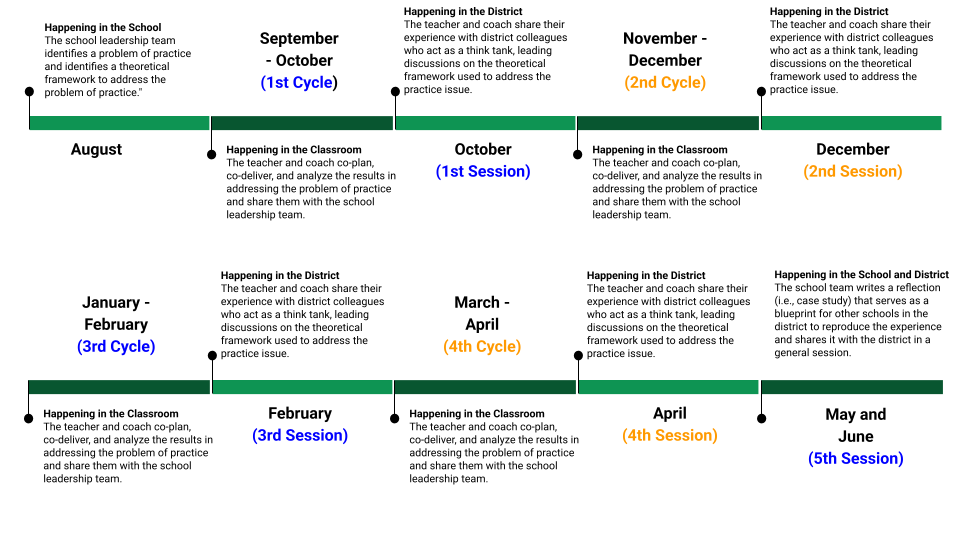
Assembling all these pieces creates a model of collaborative professional learning that highlights a set of activities anchored in the classroom and unfolds over the course of the school year, as shown in Figure 2 – Click here.
Happening in the school
A school leadership team, consisting of the principal, assistant principal, math teacher(s), and the coach, identifies several problems of practice affecting their community that they wish to address and selects a theoretical framework to guide their efforts.
Happening in the classroom
The math teacher(s) and the coach work closely together, engaging in one-on-one planning, enacting, and reflecting on a specific lesson, with a focus on teaching practices particular to mathematics. It is vital that they collect and document their efforts through notes, artifacts, samples of student work, and videos— all of which will be used to write a ‘reflection’ (i.e., case study) of the experience as a whole. In this model, with strong support from the coach, the classroom math teacher is elevated as a key driver of discussions with the larger community, which includes colleagues from across the district. It is important to emphasize that all activities in this vision of CPL stem from developments in the classroom, and these developments will be at the center of all other activities.
Happening at the district
Members from across the district, including district leaders as well as teachers and leaders from other schools, would come together to form a think tank. This think tank would engage with the teacher and coach to provide feedback on the experiences shared by the school’s teacher and coach. The agenda would center around reporting and sharing the development of classroom activities, while also serving as an opportunity for collaborative learning about the theoretical framework used to address the problem of practice. These discussions would be led by both the teacher and coach in collaboration, with special guests such as national experts or researchers potentially being recruited to participate and contribute to the conversation.
Distinctiveness
While the collaboration model for professional learning outlined in this framework integrates components that have been previously researched and implemented by many, we can assert its “distinctiveness” based on four key elements: (1) placing classroom activity at the center of collaboration; (2) consolidating multiple approaches into a unified focus (i.e., the classroom); (3) promoting vertical commitment extending from the classroom to the broader community; and (4) a dedicated focus on time and collaborative efforts.
References
Bengo, P. (2016). Secondary mathematics coaching: The components of effective mathematics coaching and implications. Teaching and Teacher Education, 60, 88-96. www.elsevier.com/locate/tate
Gonzalez, K., & Maxwell, G. (2018, October 1). Mathematics teachers’ efficacy, experience, certification and their impact on student achievement. Journal of Instructional Pedagogies, 21(1), 1-11. https://eric.ed.gov/?id=EJ1194245
Hattie, J., Fisher, D., Frey, N., Gojak, L. M., Moore, S. D., & Mellman, W. (2016). Visible Learning for Mathematics, Grades K-12: What Works Best to Optimize Student Learning. SAGE Publications.
Hussar, B., Zhang, J., Hein, S., Wang, K., Roberts, A., Cui, J., & Smith, M. (2020, May 1). The Condition of Education 2020. The Condition of Education 2020. https://nces.ed.gov/pubsearch/pubsinfo.asp?pubid=2020144
Lichtenstein, G., & Phillips, M. L. (2021, July). Comparing Online vs. In-Person Outcomes of a Hands-On, Lab-Based, Teacher Professional Development Program: Research Experiences for Teachers in the Time of COVID-19. Journal of STEM Outreach, 4(2). 10.15695/jstem/v4i2.08
Mason, L. (2010, July 2). High School Students’ Beliefs About Maths, Mathematical Problem Solving, and Their Achievement in Maths: A cross-sectional study. Educational Psychology, 23(1), 73-85. https://doi.org/10.1080/01443410303216
National Council of Teachers of Mathematics (Ed.). (2014). Principles to Actions: Ensuring Mathematical Success for All. NCTM, National Council of Teachers of Mathematics.
National Council of Teachers of Mathematics. (2024). High School Mathematics Reimagined Revitalized and Relevant. National Council of Teachers of Mathematics.
Opper, I. M. (2019, December 4). Teachers Matter: Understanding Teachers’ Impact on Student Achievement. RAND. Retrieved July 16, 2024, from https://www.rand.org/pubs/research_reports/RR4312.html
Polly, D., Wang, C., Martin, C., & Lambert, R. (2017, 3). The Influence of Mathematics Professional Development, School-Level, and Teacher-Level Variables on Primary Students’ Mathematics Achievement. School Science and Mathematics, 117, 127-136. 10.1111/ssm.12214
Rivkin, S. G., Hanushek, E. A., & Kain, J. F. (2005, June 1). Teachers, Schools, and Academic Achievement. National Bureau of Economic Research, 73(2), 417-458. 10.3386/w6691
Russell, J. L., Correnti, R., Stein, M. K., Thomas, A., Bill, V., & Speranzo, L. (2020, September). Mathematics Coaching for Conceptual Understanding: Promising Evidence Regarding the Tennessee Math Coaching Model. Educational Evaluation and Policy Analysis, 42(3), 439-466. 10.3102/0162373720940699
Saenz, M., Nandakumar, V., & Adamuti-Trache, M. (2023, April 18). A Comparative Study of High School Students’ Math Achievement and Attitudes: Do Math Teacher Qualifications Matter? International Journal of Education in Mathematics, Science and Technology, 11(2), 304-322. https://doi.org/10.46328/ijemst.2528
Xu, Z., & Swanlund, A. (2013, August). Estimating Teacher Contributions to Student Learning: The Role of the School Component. American Institute for Research. https://www.air.org/sites/default/files/Estimating-Teacher-Contributions-to-Student-Learning-Aug-2013.pdf
Yoon, K. S., Duncan, T., Wen-Yu Lee, S., Scarloss, B., & Shapley, K. L. (2007, October). Reviewing the evidence on how teacher professional development affects student achievement. Institute of Education Sciences. http://ies.ed.gov/ncee/edlabs