

Many of us math educators have lived through decades of the ‘math wars,’ debating how best to support the learning process of mathematics. On one side of the argument is the ‘traditional’ approach to learning mathematics, while on the other is ‘reform mathematics.’ The debate is how explicitly children should be taught mathematical skills: through formulas, algorithms, and step-by-step procedures, versus an inquiry-based approach where children have the opportunity to discover and make sense of the approaches and concepts that underpin these procedures.
Those who advocate for an inquiry-based approach argue that solving problems in mathematics requires the ability to flexibly apply skills to different contexts, and that such flexibility is best developed through a discovery process. Conversely, those who disagree maintain that students must first develop computational skills before they can understand mathematical concepts. Furthermore, critics of inquiry-based or ‘constructivist’ methods assert that foundational skills must precede flexible thinking.
Fueling this argument has always been the significant number of students who underperform in mathematics, compounded by the complex relationship between two types of knowledge that are widely misunderstood: conceptual and procedural knowledge. Understanding the complex relationship between them has long been hypothesized as essential for unlocking how children learn mathematics and, even more, for understanding how we think about, and do mathematics (Hiebert, 1986).
Today, it may seem that the world has moved beyond the ‘math wars,’ thanks in part to the National Mathematics Advisory Panel (2008), the National Research Council (2001, 2005), and the National Council of Teachers of Mathematics (NCTM). These organizations have influenced the debate, shifting the math community towards an inquiry-based approach to learning mathematics. What’s more, their impact extends beyond simply tipping the scales; they put forward clear recommendations that encode a relationship between these types of mathematical knowledge. The recommendation is:
Build procedural fluency from conceptual understanding
This has led to a more nuanced argument about the relative importance of ‘conceptual versus procedural knowledge.’ These organizations have taken clear positions, effectively resolving the debate. Their recommendations emphasize that math education should focus on developing both conceptual understanding and procedural fluency, but with three subtleties encoded in the choice of words. The first subtlety is the use of the word ‘from’, which suggests a direction—a flow of knowledge, indicating that procedural knowledge should be built upon a foundation of conceptual understanding. In essence, subjugating the former to the latter. The second subtlety is encoded by the word ‘fluency’, which, in this context, extends beyond its basic use as ‘the ability to produce accurate answers with efficiency’ to include the ability to choose flexibly among methods and strategies to solve problems. Lastly, the use of the word ‘understanding’, goes beyond mere ‘knowing’ by involving other cognitive abilities, such as analysis and application. It entails moving from ‘recognizing’ to ‘comprehending’ nuances among relationships, such as causation and associations (National Council of Teachers of Mathematics, 2014, p.42).
Problem solved? Not so fast. These are not simple ideas, and actions speak louder than words! Throughout my career, I have had the privilege of interacting with hundreds of math teachers, and when asked if they value conceptual understanding, almost without exception, they respond with a resounding ‘yes’. Very few would deny the need for deeper conceptual understanding. However, when observing their teaching practices, it is easy to get the opposite impression. In other words, many of us claim to value ‘conceptual understanding,’ but our actions in teaching do not always reflect this. Sometimes we act as if we believe that ‘teaching is as simple as telling.’ Which, as we all agree, it is not!
So rooted in a still not well-understood; related yet distinct set of abilities —conceptual vs procedural knowledge— it seems, now, a ‘cold war’ has taken hold. A war in which we know that conceptual understanding must precede and coincide with instruction on procedures (NCTM, 2023), but we also know that failures occur, not because we disagreed, but because teaching ‘conceptual understanding’ itself requires a great deal of expertise.
Time for some definitions! At its core, conceptual understanding is characterized by a knowledge rich in relationships: it is to gain insights by connecting ideas linked to entire networks of other ideas and relationships. It is the exact opposite of isolated pieces of information. This relationship among ideas can be simple or of immense complexity. In contrast, procedural fluency is the knowledge of algorithms and rules for completing mathematical tasks. It includes a familiarity with the symbols used to represent mathematical ideas, as well as knowledge of the syntactic rules for expressing mathematics. A key feature of procedural fluency is that its execution follows a predetermined linear sequence, moving a statement of ‘problem’ into a new state of expression, which is recognized as the ‘answer’ (Hiebert, 1986).
On the topic of conceptual understanding, a child who realizes that, when we line up decimal fractions, we end up adding tenths to tenths and hundredths to hundredths, has in that moment, made a connection and therefore conceptualized an idea involving place value, like terms and addition. This is a powerful realization that leads to a new perspective and deeper understanding. The more learners notice relationships and connect them, the higher their vantage point will be, and the more the mathematical terrain will come into focus and be understood by them. On procedural fluency, a child who multiplies the decimals 3.82 × 0.43, using a traditional procedural approach, must first write the problem in appropriate vertical form, second execute a series of numerical calculations, and third, correctly place the decimal point in the ‘answer.’
To most, it would seem self-evident that both of these types of knowledge are complementary to each other, and therefore necessary for successfully developing competency in math. But for prudent skeptics (who might need more convincing), perhaps a few additional arguments, from other domains of knowledge, would make the case.
We begin with what we know from brain research and cognitive science: ‘chunking’ is a powerful way to group information into smaller, more manageable units or ‘chunks’. By organizing information together, based on their relationships, we reduce the cognitive load and facilitate retrieval (Cowan, 2001). It follows that ‘doing mathematics’, which requires hundreds of different procedures—too many to remember as discrete pieces of information—would benefit from additional intellectual equipment (i.e.,conceptual understanding). When the learner brings to bear ‘conceptual understanding’ on the underlying rationale of procedures, ‘doing math’ becomes reasonable and enjoyable.
We continue our argument by referencing groundbreaking advances in neuroscience, which have enhanced our understanding of the mechanics involved in transferring information from short-term to long-term memory (i.e., learning). As it turns out, our five senses bombard us with stimuli from the environment. We would go crazy if it weren’t for the brain’s amazing ability to forget. Yes, forgetting is an important part of remembering. Simply put, most of the information that enters our brain is forgotten, and this is a good thing! Our brain has evolved to select which information is ‘worthy’ of moving from short-term to long-term memory. Three components are associated with ‘worthy’ information: (1) it evokes emotions, (2) it is relevant, and (3) it must make sense. Provide any one of these components to the information we share with students, and it is likely that it will be moved to long-term memory. But provide all three, and it would be nearly impossible to prevent the information from being stored in long-term memory (Kandel, 2013, pp 1441-1486). I propose that it is precisely ‘conceptual understanding’ that would activate all these three components of memory formation. When we discover a new connection, we experience the emotion best described by the phrase “aha moment.” Likewise, the very act of noticing a relationship requires us to make sense of it. And as for relevance, it is captured in the relationships among the mathematical ideas themselves.
Expanding on this argument: have you ever wondered why our brain has two hemispheres? Well, wonder no more! In his captivating book; “The Master and His Emissary…”, Iain McGilchrist, offers the most compelling explanation I have ever encountered in the literature. He suggests that our brain evolved two hemispheres to provide us with a cognitive ability known as “attention”. This ability, often taken for granted, is actually one of the most powerful functions of the human brain. The fact that humans have evolved to control attention gives us another remarkable ability: ‘agency’. Unlike most other animals, humans can direct and maintain attention on any object we choose—be it past, present, future, inward, or outward.
So, what’s the problem? Attention is unitary; we can only focus on one thread of thoughts at a time. But one system of attention wasn’t sufficient for survival. What was evolution’s solution? Two hemispheres responsible for different tasks, working together as a system capable of producing two levels of attention. One hemisphere focuses on details and specifics, while the other is concerned with the general and possibilities. When hunter-gatherers engage in the dangerous activity of hunting, the left hemisphere maintains a narrow focus on the specific, the prey, while the right hemisphere keeps attention on wider subjects, such as other humans with whom the hunter must coordinate.
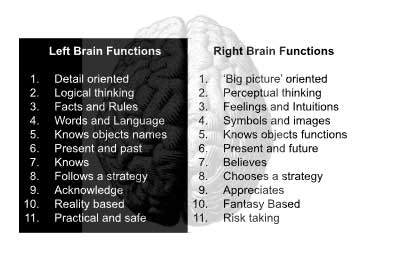
The left hemisphere is better at tasks like keeping timetables, performing long division, and solving equations through rules and procedures. It is so proficient with procedures that it has earned the name ‘The Emissary.’ In contrast, the right hemisphere is terrible with procedures but excels at seeing the whole picture, making connections, and being open to all possibilities, thus earning the name ‘The Master.’ (McGilchrist, 2012).
At the risk of overextending McGilchrist’s characterization, it follows that ‘procedural fluency’ falls within the domain of ‘The Emissary,’ while ‘conceptual understanding’ mostly belongs to ‘The Master.’ And there we have it: an entire process devised by evolution which provides us with the promise of achieving mathematical competency. It might be just me, but it seems like an infraction against Mother Nature herself, to focus on only one domain while ignoring the other. As the old saying goes, who are we to argue with nature?
Lastly, consider our everyday experiences: when was the last time you tried to reach a destination without using a GPS system? Not too long ago, GPS technology wasn’t as widely available as it is today. Ann Shannon, an insightful educator, used a powerful metaphor to encourage math teachers to reflect on their practices. With a GPS system, we can effortlessly reach even the most remote destinations, even if we’ve never been there before or are unfamiliar with the terrain. Most people are impressed by such technology’s ability to guide us through unknown areas, as it provides step-by-step instructions like “turn right,” “exit here,” or “enter the roundabout.” However, once we reach our destination, we usually have no understanding of how we got there. Consequently, the first thing we do when we need to return home is to use the GPS system again. It’s a troubling realization that, for many students, learning a math procedure feels the same way. The math teacher functions like a GPS, directing students through step-by-step procedures to reach an “answer,” but just like with a GPS system, students often have no understanding of how they arrived at the solution.
In contrast, those of a certain age can still remember a time before GPS systems existed. Back then, if we wanted to reach a remote location in unfamiliar terrain, we had to rely on maps. We were given an address or an approximate location and would open the maps to familiarize ourselves with the area. We would observe landmarks, study the roads, estimate distances and travel times, and learn about intersections and exits. We had to consider multiple routes and choose one based on criteria such as efficiency, congestion, or the sheer beauty of the road. Once we arrived at our destination, we knew exactly where we were and how to return home. Teaching ‘conceptual understanding’ is just like that (Shannon, 2019).
When reflecting on the idea of ‘building procedural fluency from conceptual understanding,’ we should ask ourselves why we want our students to learn mathematics in the first place. If the answer involves equipping our children with powerful ways of mathematical thinking, it follows that we need to develop both competencies. We may all dream of a world where citizens can reason with quantities, think critically, and communicate their thinking effectively. Such a world is possible; mother nature is on our side.
References
Cowan, N. (2001). The magical number 4 in short-term memory: A reconsideration of mental storage capacity. Psychological Bulletin, 127(1), 123-137. https://doi.org/10.1017/S0140525X01003922
Hiebert, J. (Ed.). (1986). Conceptual and Procedural Knowledge: The Case of Mathematics. L. Erlbaum Associates.
Kandel, E. R. (Ed.). (2013). Principles of Neural Science, Fifth Edition. McGraw-Hill Education.
McGilchrist, I. (2012). The Master and His Emissary: The Divided Brain and the Making of the Western World. Yale University Press.
National Council of Teachers of Mathematics (Ed.). (2014). Principles to Actions: Ensuring Mathematical Success for All. NCTM, National Council of Teachers of Mathematics.
National Council of Teachers of Mathematics. (2023, January). Procedural Fluency in Mathematics. https://www.nctm.org/Standards-and-Positions/Position-Statements/Procedural-Fluency-in-Mathematics/
National Council of Teachers of Mathematics (NCTM). (2020). catalyzing Change in Early Childhood and Elementary Mathematics: Initiating Critical Conversations. Reston, VA: NCTM.
National Research Council (NRC). (2005). How Students Learn: History, Mathematics, and Science in the Classroom. Washington, DC: National Academies Press.
National Research Council (NRC). (2012). Education for Life and Work: Developing Transferable Knowledge and Skills for the 21st Century. Washington, DC: National Academies Press.
National Research Council (U.S.). Mathematics Learning Study Committee. (2001). Adding it Up: Helping Children Learn Mathematics (J. Kilpatrick, J. Swafford, B. Findell, & National Research Council (U.S.). Mathematics Learning Study Committee, Eds.). National Academy Press.
Shannon, A. (2019). Effective Teaching Tactics: Mathematics [A set of strategies Ann Shannon shared with NYC math teachers for over a decade.]. NYS Department of Education., V. John-Steiner, & S. Scribner, Trans.). Harvard University Press.