

Professional Learning
Teachers and educators are tasked with one of the most difficult challenges – to prepare the next generation and future leaders of our country. To do so, they need the most comprehensive and forward thinking approaches to teaching. proficientED’s Arc of Learning not only prepares teachers by developing their teaching skills, but also provides the opportunity to grow through professional learning communities, utilizing best practices and new approaches so they can connect and communicate with their students.
There is a vast body of research and consensus among educators that establishing professional learning communities (PLCs) can have a major effect on the quality of teaching, which plays a significant role in addressing social inequalities.
Arc of Learning
proficientED utilizes an Arc of Learning as well as Professional Learning Communities to incorporate critical components for teacher’s professional development. How does proficientED do this? By designing a program focused on boosting math progress and mastery, our professional learning empowers teachers by providing them with these key skills for success in math education:
Click an icon on the right to see more information about that skill.
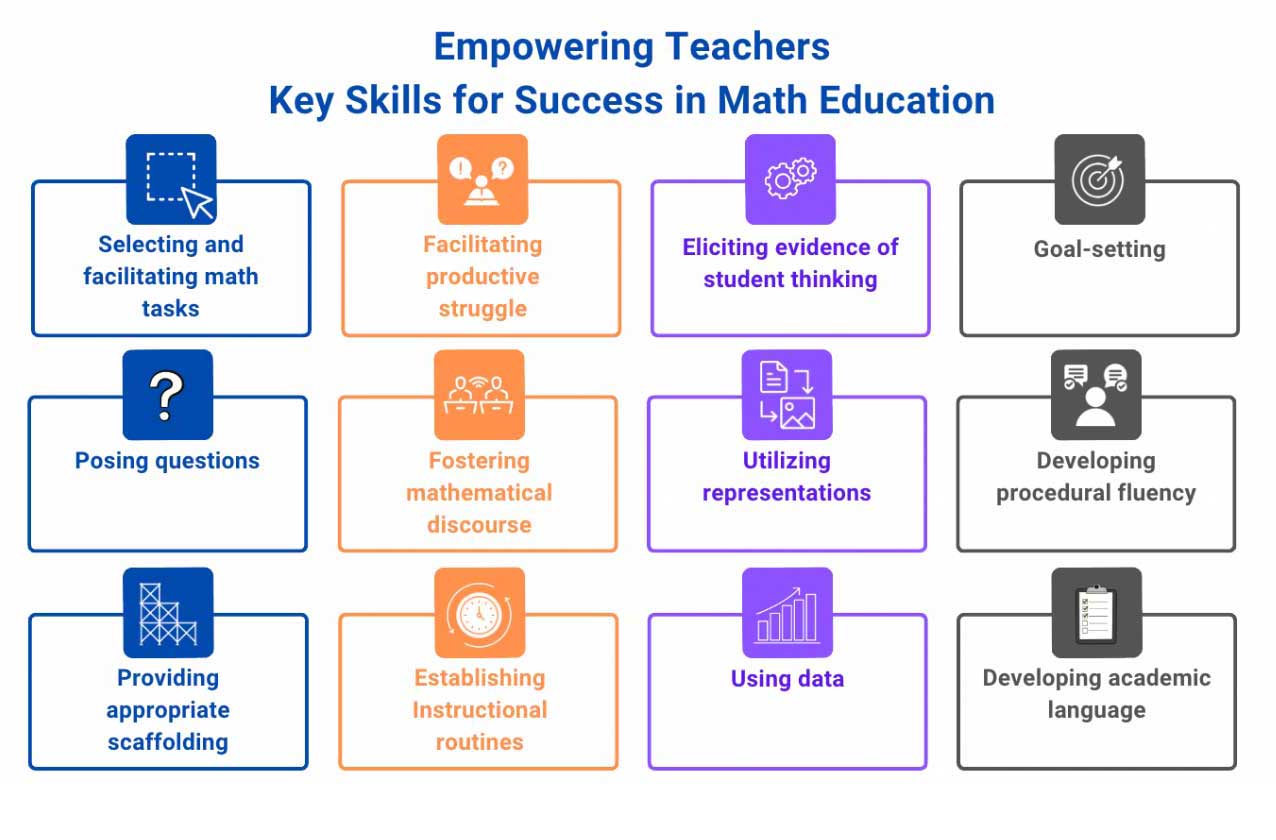
Selecting and facilitating math tasks – In order to afford students an opportunity to engage in high-level thinking, teachers must regularly select and implement mathematical tasks from their curriculum materials that are cognitively demanding and that promote reasoning and problem solving. Such tasks rely on prior knowledge and offer access to mathematics through multiple entry points, including the use of different representations and tools, and they foster the solving of problems through varied solution paths and strategies.
Facilitating productive struggle – When students engage in productive struggle, first they need the ability to make sense of the situation, to see what’s going on, and to have had experience using strategies to solve other problems in the past, to see what might work. They build the resourcefulness to envision other potential strategies to try, and the flexibility to attempt them. Above all, they develop the determination to persevere, even when the path to solving a problem isn’t straightforward.
Eliciting evidence of student thinking – Focusing on evidence includes identifying indicators of what is important to notice in students’ mathematical thinking, planning for ways to elicit that information, interpreting what the evidence means with respect to students’ learning, and then deciding how to respond on the basis of students’ understanding.
Goal-setting – Establishing clear goals not only guides teachers’ decision-making during a lesson, but also focuses students’ attention on monitoring their own progress toward the intended learning outcomes, so that they can become agents of their own learning (i.e., agency).
Posing questions – that encourage students to explain and reflect on their thinking is an essential component of meaningful mathematical discourse. Purposeful questions allow teachers to discern what students know and adapt lessons to meet varied levels of understanding, and promotes a metacognitive approach to learning mathematics. These can also help students to make important mathematical connections, and support them in posing their own questions.
Fostering mathematical discourse – includes the purposeful exchange of ideas through classroom discussion, as well as through other forms of verbal, visual, and written communication. This has the goal of building knowledge and developing a language for expressing mathematical ideas, and gives students opportunities to share ideas and clarify understandings, construct convincing arguments regarding why and how things work, and learn to see things from other perspectives.
Utilizing representations – These embody critical features of mathematical constructs and actions, such as drawing diagrams, using words or writing equations. When students learn to represent, discuss, and make connections among mathematical ideas in multiple forms, they demonstrate deeper understanding and enhanced problem-solving abilities. The regular use of representations provides an opportunity to accelerate learning.
Developing procedural fluency from conceptual understanding – When students see mathematical procedures not as isolated rules to memorize, but as examples of concepts that are connected with other ideas, procedures become a versatile tool, depending on contextual needs. Conceptual understanding is the engine behind the ability to flexibly apply mathematical knowledge in different situations.
Providing appropriate scaffolding – High expectations and the unwavering belief that students can succeed is of paramount importance to students’ academic achievement. However, many students need additional support. But support should not lower the rigor of mathematics. Thus, scaffolding is essential to support math learned. Scaffolds are temporary instructional supports that allow the learner to engage with the complexity of mathematics without degrading its rigor. Striking the right balance between keeping the rigor of the mathematics while providing adequate support, describes the challenges of scaffolding in mathematics. Scaffolding bridges the distance between what students can do on their own and what they can do with the support of a more expert facilitator as determined by their zones of proximal development. (Vygotsky, 1978)
Establishing Instructional routines – provide structure and clear expectations to students. Once established, students know what to do, what to expect, how to participate and to regulate their learning. This supports both teachers and learners by liberating cognitive space and allowing them to redirect all cognition to what matters most: learning and teaching.
Using data – Improving the activity of learning and teaching requires data. Simply put, it is not possible to improve without information, without measurement, without comparison. The very action of moving from ‘not-effective’ to ‘effective’ requires both a compass that points to the right direction, and a tool that measures effectiveness. That compass, that tool for effectiveness, is what we call data. Failing to integrate the use of data in improving instruction is equivalent to ‘flying blind’. But data that is useful for such efforts is different from other sets of data. Useful data for the process of learning and teaching reveals students’ thinking, and ways of making sense. It must be data that informs instruction (strengthening core instruction). It must be data that diagnoses learning problems and that monitors students’ progress to well-established goals. Finally, it must be data useful for prescribing a solution (i.e., interventions).
Developing academic language – The relationship between language and knowledge is well understood. Our brain encodes knowledge into language patterns that allow us to use language to make connections and organize knowledge, in ways that allow us to apply it to different contextual situations . Therefore deepening an understanding of how language mediates content, and how to promote academic language development is an essential part of adult learning.
proficientED
Online, Synchronous Learning Experience
Structured as active learning, our professional learning encourages peer-to-peer discussion and incorporates breakout rooms for continuous discussion throughout each module.
proficientED is an online, synchronous learning experience that provides a dynamic and engaging way to build teaching skills. This includes:
Real-Time Interaction and Collaboration: Engage in dynamic dicussions, share ideas, and learn from your peers in a live environment.
Expert-Led Instruction: Access high-quality, interactive instruction from leading educators in your field.
Flexible Learning: Attend sessions from the comfort of your own home or school, fitting learning into your busy schedule.
Immersive Experience: Enjoy dynamic presentations, interactive activities, and engaging discussions that bring learning to life.
Convenient Access to Resourses: Easily access materials and additional resources from the platform, anytime, anywhere.
“We believe the greatest impact we can have on a student’s academic experience is to provide teachers with the necessary skills to build a stronger classroom community.”
– David Irving, Founder, CollegeReadyMath
Working Hand-in-Hand for Student Success
Over the last 20+ years, our companies have partnered with teachers, parents and students to provide education guidance for academic success. This includes:- Principals and teachers with coaching and professional development training
- Parents with instructional guidance and parental involvement workshops
- Students with tutoring and instruction in literacy and mathematics
Learn More About Our Program